Ashtanga means “eight limbs” in Sanskrit. The word has two meanings in yoga today. The older one is Patanjali’s eight-limbed path from the Yoga Sutras, a complete map of yoga from ethics to meditation. The newer one is Ashtanga Vinyasa yoga, the dynamic, set-sequence style of posture practice taught by K. Pattabhi Jois in Mysore, India, from the 20th century onwards.
This guide explains both: what the eight limbs actually are, how the modern Ashtanga practice works, what a class feels like, who it suits, and how to start without getting hurt.
Two Meanings of “Ashtanga Yoga”
| Patanjali’s Ashtanga (the eight limbs) | Ashtanga Vinyasa yoga (the practice style) | |
|---|---|---|
| What it is | A philosophical path to a still, clear mind | A dynamic sequence of postures linked with breath |
| Source | The Yoga Sutras of Patanjali, chapter 2, from sutra 29 | Taught by K. Pattabhi Jois, who learned from T. Krishnamacharya |
| Date | Compiled in the early centuries CE (many scholars favour around 400 CE) | Taught in Mysore from the mid-20th century; Jois founded his institute in 1948 |
| Focus | Ethics, discipline, posture, breath, inward attention, concentration, meditation, absorption | Mainly the third and fourth limbs (posture and breath), practised as a moving meditation |
The two are connected. Practitioners of Ashtanga Vinyasa see their daily posture practice as a doorway to Patanjali’s whole path. As Pattabhi Jois is often quoted as saying, the practice is “99% practice, 1% theory”.
The Eight Limbs of Yoga, Explained Simply
Patanjali defines yoga in his second sutra as yogas chitta vritti nirodhah: yoga is the stilling of the movements of the mind. The eight limbs are his practical method for getting there. They move from outer conduct inward.
1. Yama: how you treat others
The five restraints (Yoga Sutra 2.30):
- Ahimsa: non-harming, in action, word and thought
- Satya: truthfulness
- Asteya: not stealing, including time and credit
- Brahmacharya: moderation of the senses, traditionally celibacy
- Aparigraha: non-grasping; not accumulating more than you need
2. Niyama: how you treat yourself
The five observances (Yoga Sutra 2.32):
- Shaucha: cleanliness of body and mind
- Santosha: contentment
- Tapas: disciplined effort, the “heat” of practice
- Svadhyaya: self-study and study of sacred texts
- Ishvara pranidhana: surrender or devotion to the divine
3. Asana: posture
Patanjali says very little about postures. His definition is just three words: sthira sukham asanam, a posture should be steady and comfortable (2.46). For him, asana mainly meant a stable seat for meditation. The many postures of modern yoga come largely from the later Hatha tradition and 20th-century teachers.
4. Pranayama: breath regulation
Once the seat is steady, the breath is refined and lengthened. In the Ashtanga Vinyasa practice, this happens through slow, even breathing during movement.
5. Pratyahara: drawing the senses inward
Attention turns away from sights, sounds and distractions towards inner experience. In practice, this is the moment when the room fades and you’re absorbed in what you’re doing.
6. Dharana: concentration
Holding attention on one object: the breath, a mantra, a point of focus.
7. Dhyana: meditation
When concentration becomes a steady, unbroken flow of attention.
8. Samadhi: absorption
Complete absorption, where the sense of a separate observer falls away. Patanjali describes several levels of samadhi as the goal of the path.
The first five limbs are sometimes called the outer limbs, and the last three, practised together, the inner limbs (samyama). If this philosophy interests you, our guide to the philosophy of Hatha yoga shows how later traditions built on it.
Where Ashtanga Vinyasa Yoga Comes From
The modern Ashtanga practice traces back to T. Krishnamacharya, the influential teacher who taught yoga at the Jaganmohan Palace in Mysore under the patronage of the Maharaja in the 1930s. Among his students were K. Pattabhi Jois (1915–2009), who developed Ashtanga Vinyasa, and B.K.S. Iyengar, whose own precise style became Iyengar yoga.
Jois studied with Krishnamacharya for many years and founded the Ashtanga Yoga Research Institute at his home in Mysore in 1948. Western students began arriving in the 1960s and 1970s, and the practice spread worldwide. After Jois’s death in 2009, his grandson R. Sharath Jois led the institute, later renamed the K. Pattabhi Jois Ashtanga Yoga Institute, and then his own Sharath Yoga Centre. Sharath Jois died unexpectedly in November 2024, aged 53, and the tradition is now carried on by his family, senior students and authorised teachers around the world.
Jois said the sequences came from an ancient text called the Yoga Korunta, which Krishnamacharya studied. No copy of that text has ever been found, so scholars can’t verify it. Many historians see Ashtanga Vinyasa as a 20th-century system that combined older Hatha yoga with new ideas. That doesn’t make the practice any less valuable; it simply means it’s younger than its reputation.
The history also has a difficult chapter. In recent years, several former students described inappropriate physical adjustments by Pattabhi Jois, and Sharath Jois publicly apologised for them in 2019. Today, good Ashtanga teachers ask for consent before touching students, and you can always decline hands-on adjustments.
How Ashtanga Vinyasa Yoga Works: Tristhana
The practice rests on three things done together, called tristhana (“three places of attention”):
| Element | What it means | In practice |
|---|---|---|
| Breath (ujjayi) | Slow, steady breathing through the nose with a slight constriction at the back of the throat, making a soft, even sound | Each movement is matched to an inhale or exhale; most postures are held for five breaths |
| Posture and bandhas | The asana itself, supported by internal “locks”: mula bandha (pelvic floor) and uddiyana bandha (lower belly) | The bandhas give lightness and stability, especially in jumps and transitions |
| Gaze (drishti) | A set point of focus for each posture | Nine drishtis are used: nose, third eye, navel, hand, toes, thumbs, far left, far right and upwards |
Together, these turn the practice into a moving meditation. When the breath, body and gaze are all occupied, there’s little room left for the mind to wander.
Vinyasa: linking postures with breath
Vinyasa means a linked sequence of movement and breath. In Ashtanga, each posture has a fixed count of breaths to enter and exit, and transitions between seated postures usually pass through a short flowing sequence: lift, jump back to plank, lower, upward-facing dog, downward-facing dog, and jump forward. These vinyasas create the steady heat Ashtanga is known for.
The Six Series of Ashtanga
Ashtanga postures are arranged in fixed sequences, called series. You learn them in order, adding new postures only when the earlier ones are steady.
| Series | Sanskrit name | Meaning and focus |
|---|---|---|
| Primary series | Yoga Chikitsa | “Yoga therapy”: forward bends, hip openers and core work to realign and strengthen the body |
| Intermediate series | Nadi Shodhana | “Nerve cleansing”: backbends, twists and leg-behind-head postures |
| Advanced series A–D | Sthira Bhaga | “Divine stability”: demanding arm balances and strength postures |
Most practitioners spend years on the primary series, and many never go further. That’s not a failure. The primary series alone is a complete, lifelong practice. For a pose-by-pose guide, see our article on the Ashtanga primary series.
The Structure of a Primary Series Practice
Every Ashtanga practice follows the same overall shape:
| Part | What it includes | Purpose |
|---|---|---|
| Opening chant | A short Sanskrit invocation honouring the lineage and Patanjali | Settle the mind and set an intention |
| Sun salutations | Five rounds of Surya Namaskar A and three to five of Surya Namaskar B | Warm the body and establish the breath |
| Standing sequence | Forward bends, triangle and side-angle postures, wide-leg folds, balances and warrior poses | Build strength, balance and alignment |
| Seated sequence | Forward bends, twists, hip openers and core postures of the series | The heart of the practice |
| Finishing sequence | Backbend, shoulder stand and related postures, headstand, lotus postures | Cool down and balance the system |
| Rest | Lying in relaxation | Let the practice settle |
| Closing chant | A short Sanskrit verse for peace | Close the practice |
A full primary series takes most experienced practitioners around 90 minutes. Beginners practise a much shorter version: sun salutations, part of the standing sequence and the finishing postures, adding more over time.
Sun Salutation A, Breath by Breath
Every Ashtanga practice begins with Surya Namaskar A. It is the best place to understand vinyasa, because each movement has its own breath and its own count. Start standing in samasthiti, feet together, arms by your sides, gaze at the tip of the nose.
| Count | Breath | Movement | Gaze |
|---|---|---|---|
| 1 (ekam) | Inhale | Raise the arms overhead, palms together | Thumbs |
| 2 (dve) | Exhale | Fold forward (Uttanasana) | Nose |
| 3 (trini) | Inhale | Lift the chest halfway, spine long | Third eye |
| 4 (chatvari) | Exhale | Step or jump back and lower to Chaturanga Dandasana | Nose |
| 5 (pancha) | Inhale | Upward-facing dog (Urdhva Mukha Svanasana) | Third eye |
| 6 (shat) | Exhale | Downward-facing dog (Adho Mukha Svanasana); stay for five breaths | Navel |
| 7 (sapta) | Inhale | Step or jump forward, lift halfway | Third eye |
| 8 (ashtau) | Exhale | Fold forward | Nose |
| 9 (nava) | Inhale | Rise up, arms overhead | Thumbs |
| Samasthiti | Exhale | Lower the arms and stand still | Nose |
Beginners usually step back and forward rather than jump, and lower the knees in Chaturanga. Both are perfectly good Ashtanga. What matters is that the breath leads and the body follows, not the other way round. Five slow rounds of this sequence, done every morning, are a complete practice for your first weeks.
The Standing Sequence: Correct Pose Names
Many websites list Ashtanga poses with garbled or invented names. These are the standing postures of the primary series, in order, with their usual names:
| Sanskrit name | English name | Main action |
|---|---|---|
| Padangusthasana | Big-toe forward bend | Hamstrings and spine |
| Padahastasana | Hands-under-feet forward bend | Deeper hamstring stretch |
| Utthita Trikonasana | Extended triangle | Side body and legs |
| Parivrtta Trikonasana | Revolved triangle | Twist and balance |
| Utthita Parsvakonasana | Extended side angle | Leg strength, side stretch |
| Parivrtta Parsvakonasana | Revolved side angle | Deep twist |
| Prasarita Padottanasana A–D | Wide-leg forward bends | Inner legs, shoulders (in C) |
| Parsvottanasana | Intense side stretch | Hamstrings, wrists and shoulders |
| Utthita Hasta Padangusthasana | Extended hand-to-big-toe | Balance and hamstrings |
| Ardha Baddha Padmottanasana | Half-bound lotus forward bend | Hips and balance (use care with knees) |
| Utkatasana | Chair pose | Legs and heat |
| Virabhadrasana A and B | Warrior I and II | Strength and stamina |
The seated postures that follow, from Dandasana and Paschimottanasana through Marichyasana and Navasana, are described one by one in our guide to the primary series.
Mysore Style vs Led Classes
Ashtanga is taught in two ways, and the difference surprises many newcomers.
| Mysore style | Led class | |
|---|---|---|
| How it works | Each student practises their own sequence at their own pace, in a group room; the teacher moves around, giving individual instruction | The teacher counts the breaths and leads the whole room through the sequence together, in Sanskrit |
| Best for | Learning the sequence step by step and getting personal attention | Learning the correct breath count and rhythm |
| Beginners | Ideal; you’re given only what you’re ready for | Can feel fast at first |
Traditional Ashtanga is mostly taught Mysore style, named after the city where it developed, with a led class once or twice a week.
Traditional Practice Customs
- Six days a week. The traditional practice is daily, with one rest day, usually Saturday.
- Moon days. Practitioners traditionally rest on full-moon and new-moon days.
- Early morning. Ashtanga is traditionally practised early, on an empty stomach.
- Rest during menstruation. Many traditional schools suggest women take the first days of their period off, known as a “ladies’ holiday”. Today this is generally treated as a personal choice.
Benefits of Ashtanga Practice
People who practise Ashtanga regularly commonly report:
- Strength and stamina: the vinyasas involve repeated lifting and lowering of your own body weight.
- Flexibility: the many forward bends and hip openers gradually increase range of motion.
- Focus: the set sequence and fixed gaze points train attention, and many describe it as a moving meditation.
- Discipline and routine: a fixed daily practice builds consistency that carries into the rest of life.
- Stress relief: steady breathing and absorbed attention leave many people calmer afterwards.
Research on yoga generally supports benefits for stress, wellbeing, balance and flexibility, though few studies look at Ashtanga specifically. The US National Center for Complementary and Integrative Health also notes that yoga is generally safe when practised appropriately, but that injuries can happen, and that some people should adapt or avoid certain practices.
How Safe Is Ashtanga? What the Research Shows
Ashtanga’s reputation for injuries is not just gossip, but it needs context. The only survey focused solely on Ashtanga practitioners questioned 110 students at three Finnish centres in 2005. Published in the International Journal of Yoga Therapy, it found that 62% had had at least one injury lasting more than a month. The most common sites were the hamstrings, knees and lower back, and no one reported permanent impairment. Only about a third of the invited practitioners replied, so the true figure may be lower or higher.
A much larger German survey of 1,702 practitioners of many styles, published in BMC Complementary and Alternative Medicine in 2019, found that about one in five had experienced at least one acute adverse effect, mostly musculoskeletal. Chronic problems were more likely among people with existing illnesses and those who practised only on their own, without supervision.
The practical lessons are clear:
- Hamstrings: the primary series contains many forward bends. Bend the knees and fold from the hips rather than pulling yourself down.
- Knees: lotus and half-lotus postures rotate the hip, not the knee. If the hip is tight, the knee takes the strain. Use the modified versions until the hips open.
- Lower back: avoid rounding hard into forward bends or forcing backbends. A smooth breath is the best warning system you have.
- Supervision matters: a good teacher catches habits before they become injuries.
Your First Month of Ashtanga: A Simple Plan
| Week | Practice (3–5 times a week) | Approx. time |
|---|---|---|
| 1 | 5 × Sun Salutation A, then the three finishing lotus postures (or cross-legged), then rest | 20 minutes |
| 2 | Add 3 × Sun Salutation B | 30 minutes |
| 3 | Add the first standing postures: the two forward bends and the triangles | 40 minutes |
| 4 | Add side angles, the wide-leg forward bends and the short finishing sequence | 45–50 minutes |
Keep a longer rest at the end than you think you need: at least five minutes. If any week leaves you sore for days, repeat it rather than adding more. The sequence will still be there next month.
What a First Mysore Class Feels Like
Walking into a Mysore room for the first time can be strange. Twenty people are breathing loudly, each doing something different, and no one is giving instructions to the group. You’ll usually be asked to arrive early, roll out your mat and tell the teacher you’re new. They’ll show you the first sun salutation, watch you do a few rounds, then add a little more. A first class often lasts only 30 to 40 minutes, and that’s normal.
Most people find, within a few sessions, that the quiet sound of everyone’s breath becomes calming rather than intimidating. Because you’re not following anyone, there’s no pressure to keep up. Many practitioners say this is where the practice first starts to feel like meditation.
Taking the Eight Limbs Off the Mat
For all its physical intensity, the point of Ashtanga is the whole eight-limbed path. A few simple ways to bring the other limbs into everyday life:
- Ahimsa in practice: not injuring yourself is the first application of non-harming. Choose the modified pose without guilt.
- Santosha: be content with today’s practice, even when a posture felt easier yesterday.
- Svadhyaya: read a short passage of the Yoga Sutras each week and notice what it says about your own habits.
- Dharana and dhyana: sit quietly for five minutes after practice, following the breath. Our guide to mindfulness gives simple ways to start.
Over time, the discipline of turning up to the mat each morning tends to spill into other areas: sleep, food, how you handle difficult conversations. That, more than any posture, is what experienced practitioners mean when they say the practice changed them.
Is Ashtanga Good for Beginners?
Ashtanga has a reputation for being tough, and the full primary series is. But traditional Ashtanga was always taught one posture at a time, so a true beginner never does the whole thing.
It suits beginners who:
- Like structure and knowing exactly what to expect
- Want a physically active practice that builds strength
- Can commit to practising several times a week
- Are willing to go slowly and accept modifications
It may suit you less if you have injuries, low energy or joint problems, or if you want a very gentle practice for stress. A slower Hatha practice may be a better starting point; our honest answer to “Is Hatha yoga hard?” compares the experience.
Ashtanga vs Vinyasa vs Hatha
| Ashtanga | Vinyasa (flow) | Hatha | |
|---|---|---|---|
| Sequence | Fixed, the same every time | Changes from class to class | Varies; often slower and simpler |
| Pace | Steady and continuous | Flowing, often creative | Slower, with longer holds |
| Intensity | High | Moderate to high | Gentle to moderate |
| Best for | Structure, discipline, strength | Variety and creativity | Beginners, alignment, calm |
Vinyasa flow classes grew out of Ashtanga. Western teachers kept its breath-linked movement but dropped the fixed sequence.
How to Start Ashtanga Safely
- Learn from a teacher, ideally Mysore style. The individual attention makes a real difference.
- Start short. Sun salutations and a few standing postures are a complete beginner practice.
- Prioritise the breath. If you can’t breathe smoothly through your nose, slow down or ease off.
- Don’t force lotus or binds. Knees and shoulders are the most common injury sites in Ashtanga. Use modifications without embarrassment.
- Be wary of strong adjustments. You can always say no to hands-on help.
- Practise regularly but sustainably. Three short practices a week beat one long, exhausting one.
- Rest when you’re tired or unwell. Traditional rest days exist for good reason.
Common Mistakes
- Chasing postures. Pushing into deep forward bends or lotus before the body is ready is the fastest route to injury.
- Holding the breath in difficult postures. The breath is the practice; if it stops, back off.
- Skipping the finishing sequence when short of time. It balances the body; shorten the middle instead.
- Treating it as a workout only. Without the breath and gaze, Ashtanga becomes exercise rather than yoga.
- Comparing yourself with others in a Mysore room. Everyone is on a different part of their own sequence.
Practising Ashtanga at Home
Because the sequence never changes, Ashtanga is one of the easiest styles to practise alone once you’ve learned it. That’s also its trap: without a teacher, small habits go unnoticed for years. A sensible balance for most people is a self-practice at home on most days, with a class or a check-in with a teacher every week or two.
| Home practice | Studio or Mysore room | |
|---|---|---|
| Strengths | Free, flexible timing, builds self-reliance | Individual corrections, a new posture when you’re ready, group energy |
| Risks | Unnoticed alignment habits, pushing too far, skipping the finishing postures | Comparing yourself with others, strong adjustments you didn’t want |
| Best for | People who already know their sequence | Beginners and anyone adding new postures |
Practical tips
- Use a grippy mat. Ashtanga makes you sweat, and a slippery mat makes jumps and Downward Dog hard work. Many practitioners lay a cotton rug or towel on top.
- Eat lightly beforehand. Practise on an empty stomach or two to three hours after a meal. A glass of warm water first is enough for most people.
- Keep the room comfortable, not hot. Ashtanga generates its own heat. Extreme heat makes overstretching easier.
- Learn the count. Listening to a led class a few times helps you learn the breath rhythm, which keeps your self-practice honest.
- Write it down. Note the postures you’ve been given and any adjustments. It saves you adding poses before you’re ready.
Practising in Kathmandu’s climate
The Kathmandu Valley sits at around 1,400 metres. Winter mornings, from December to February, can be cold, so morning practice often starts with stiff muscles: take extra sun salutations before deeper postures. During the monsoon (roughly June to September), humid mornings make the body warm up faster, and that’s when it’s easiest to overstretch. Spring and autumn are the most comfortable seasons for a long daily practice, which is one reason many students choose them for retreats and courses.
How to Choose an Ashtanga Teacher
A good teacher matters more in Ashtanga than in most styles, because you’ll repeat the same postures thousands of times. Look for these signs:
- They give you less, not more. A teacher who keeps you on the standing sequence until it’s steady is protecting you.
- They ask before touching. Consent for hands-on adjustments should be routine, and saying no should be easy.
- They offer modifications for lotus, binds and jump-throughs without treating them as second best.
- They ask about injuries and health conditions before your first class.
- They still practise themselves. Experienced Ashtanga teachers usually keep a daily practice and have studied with senior teachers over many years.
- They teach the whole path. Breath, gaze and the ideas behind the eight limbs should be part of the teaching, not just the postures.
Don’t be put off by a teacher who seems slow to add postures. In Ashtanga, patience is part of the method.
Learning Ashtanga in Nepal
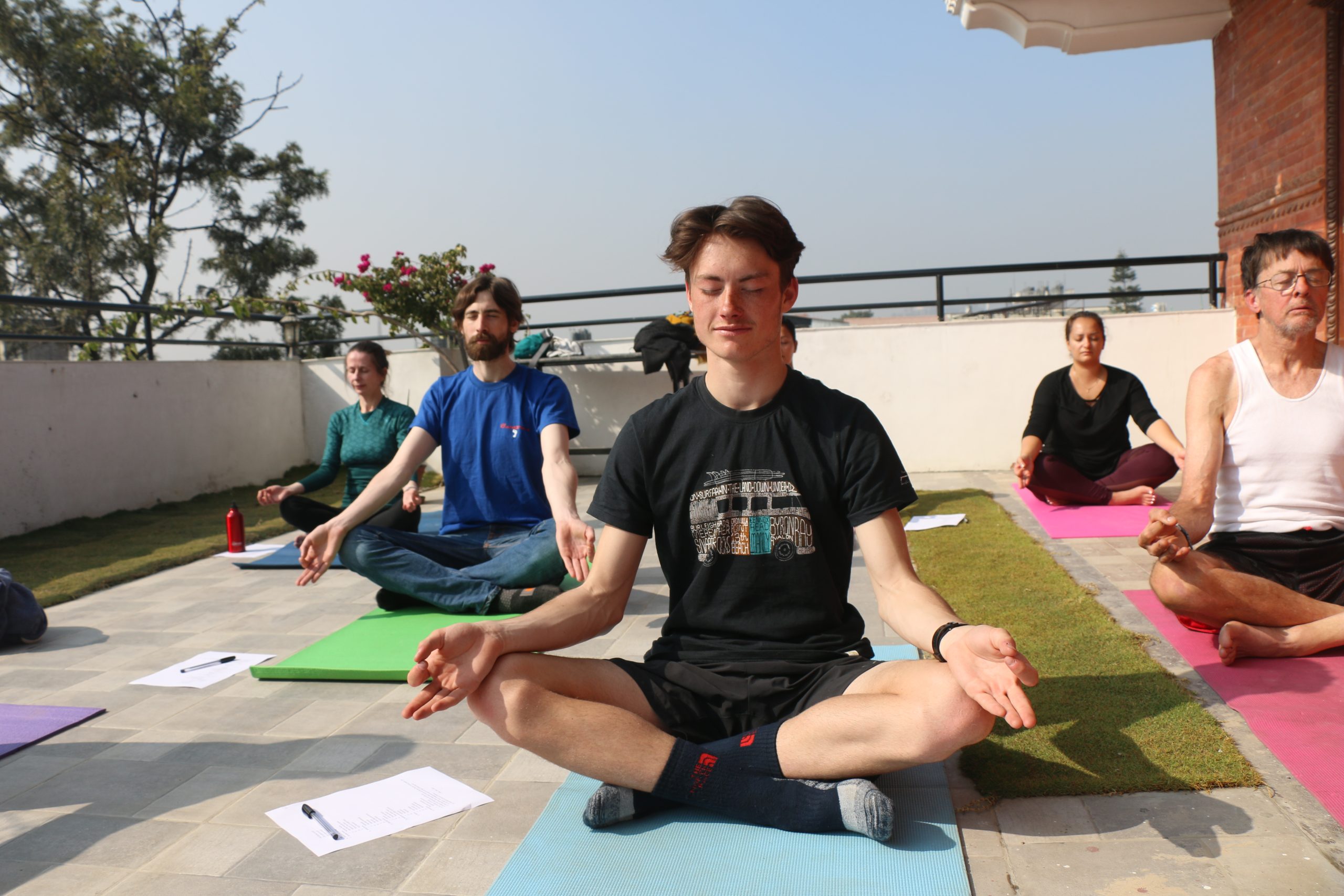
Nepal Yoga Institute teaches Ashtanga-based practice alongside classical Hatha yoga at its ashram in Budhanilkantha, below Shivapuri National Park on the northern edge of the Kathmandu Valley. Small groups mean teachers can introduce the sequence gradually and adapt it to each student, which is close to the spirit of Mysore-style teaching.
Mornings begin with chanting and pranayama before the asana practice. Our guide to Om chanting explains the opening practice, and our article on yoga classes in Kathmandu describes a typical day.
- The five-day yoga retreat is a good way to try daily practice.
- The 200-hour yoga teacher training covers Ashtanga and Hatha practice, the eight limbs and the Yoga Sutras in depth.
Practising in Nepal also connects you to the older roots of yoga’s lineages; our article on the origin of yoga in Nepal tells that story.
Frequently Asked Questions About Ashtanga Yoga
1. What does Ashtanga mean?
Ashtanga is Sanskrit for “eight limbs” (ashta = eight, anga = limb). It refers to Patanjali’s eight-limbed path in the Yoga Sutras.
2. What are the eight limbs of yoga?
Yama (restraints), niyama (observances), asana (posture), pranayama (breath regulation), pratyahara (drawing the senses inward), dharana (concentration), dhyana (meditation) and samadhi (absorption).
3. Who founded Ashtanga yoga?
The eight limbs come from Patanjali’s Yoga Sutras. The modern Ashtanga Vinyasa practice was developed and taught by K. Pattabhi Jois in Mysore, who learned from T. Krishnamacharya and founded his institute in 1948.
4. How long does an Ashtanga class take?
A full primary series takes around 90 minutes for experienced practitioners. Beginner practices are much shorter, often 30–60 minutes.
5. How many series are there in Ashtanga?
Six: the primary series, the intermediate series and four advanced series (A to D). Most people practise the primary series for years.
6. Is Ashtanga yoga hard?
The full sequence is physically demanding. But beginners learn it one posture at a time, so the early stages are manageable with modifications.
7. What is Mysore style?
A way of teaching where each student practises their own sequence at their own pace in a group room, while the teacher gives individual guidance. It’s named after Mysore, where Ashtanga was developed.
8. What is ujjayi breathing?
Slow breathing through the nose with a slight constriction at the back of the throat, producing a soft, steady sound. It’s used throughout Ashtanga practice to keep the breath even.
9. What are bandhas?
Internal “locks”. In Ashtanga, mula bandha (a gentle lift of the pelvic floor) and uddiyana bandha (drawing in the lower belly) are used to support the body during postures and transitions.
10. Why don’t Ashtangis practise on moon days?
It’s a traditional custom to rest on full-moon and new-moon days. In practice, it also gives regular rest days in a demanding routine.
11. How is Ashtanga different from vinyasa yoga?
Ashtanga follows a fixed sequence every time; vinyasa flow classes change the sequence from class to class. Vinyasa flow developed from Ashtanga.
12. Can Ashtanga help with weight loss?
It’s physically active and builds strength, so it can support a healthy weight alongside diet and lifestyle. It isn’t a weight-loss programme in itself.
13. Is Ashtanga safe if I have injuries?
Talk to your doctor and teacher first. Many postures can be modified, but knees, hips, shoulders and wrists need care, and some people are better suited to a gentler style.
14. Where can I learn Ashtanga in Nepal?
Several schools in Kathmandu and Pokhara teach Ashtanga. Nepal Yoga Institute in Budhanilkantha teaches Ashtanga-based practice alongside Hatha yoga in small groups, during retreats and teacher training.
Ashtanga asks for consistency more than flexibility. Start with a few sun salutations, breathe steadily and let the sequence grow over months, not days. If you’d like guidance as you begin, we’d be glad to welcome you to the mat in Budhanilkantha.